When homeowners decide to transform their outdoor spaces, they picture gardens, flowers, and lawns. While living elements bring life to a yard, they can’t survive without a proper foundation. That foundation relies entirely on solid, non-living structures. This is where hardscaping contractors step in. They handle the stone, concrete, brick, and wood elements that give an outdoor area its shape.
Before anyone plants a single shrub or lays down sod, the structural framework must be in place. By tackling grading, drainage, and spatial organization, these professionals create the groundwork that allows living elements to thrive. Without this preparation, soil shifts, plants die, and yards become unusable. The order of operations matters. You don’t plant seeds and then pour concrete. You build the structure first, and then you fill in the rest.
Establishing Foundation and Flow
Any outdoor design requires a logical layout. If you don’t define where people will walk, sit, and gather, the yard becomes a chaotic mix of grass and dirt. Hardscaping contractors solve this problem by carving out distinct paths and gathering spaces. They install walkways, patios, and decks that guide movement throughout the property. Without clear paths, foot traffic destroys grass and compacts soil, making it impossible for plants to grow.
When you hire experts to map out this flow, they look at the natural slopes and boundaries of the property. They determine efficient ways to move from the back door to a seating area or a garden bed. They consider how guests move through the space during a gathering. Retaining walls play a crucial role here. If a yard has steep slopes, retaining walls hold back the earth and create flat, usable terraces. These level areas become the canvas for planting beds or lawns. By setting physical boundaries early on, hardscaping contractors ensure that future plant life has designated, protected spaces to take root. You don’t want plants sprawling into walkways, and you don’t want people trampling fragile roots. Stone and brick act as a permanent boundary, keeping the yard organized and accessible year after year.
Managing Water and Drainage
Water management is a hidden but essential part of outdoor design. If a yard doesn’t drain properly, water pools in low areas, drowns plant roots, and washes away topsoil. Landscaping won’t survive in a swampy yard or an eroded slope. Hardscaping contractors address these issues long before the first seed goes into the ground. They grade the land, altering the slope so water flows away from the house and away from vulnerable garden beds. They move dirt from high spots to low spots, reshaping the earth to control runoff.
Beyond grading, they install complex drainage solutions. French drains, catch basins, and permeable pavers allow water to seep into the ground safely or move toward municipal storm drains. When it rains, water hits the patio and follows a specific path designed by the installation team. This planning prevents soil erosion. If you plant a garden on a slope without retaining walls or drainage channels, the rainstorm will wash the soil and the plants away. By controlling where water goes, the structural team ensures the soil remains intact, and plants receive the right amount of moisture without drowning. Water is diverted away from building foundations and directed toward areas that need it, or channeled off the property safely.
Creating Functional Zones
Modern yards serve multiple purposes. Homeowners want a place to cook, a place to relax around a fire, and a place for children or pets to play. Creating distinct zones requires solid boundaries and stable surfaces. Hardscaping contractors build the framework for these activities. They construct outdoor kitchens, fire pits, seating walls, and pergolas. These elements define the purpose of each section of the yard. Building these structures requires planning for utilities. Gas lines for fire pits and electrical wiring for lighting must go into the ground before the surface materials get laid down.
Once construction finishes, the space might look rigid. That is exactly the point. Stone, brick, and concrete provide the bones of the design. Afterward, plants soften the edges. A pergola provides structure, but climbing vines provide shade. A stone retaining wall offers seating, while shrubs planted behind it provide privacy. Hardscaping contractors know they are building a stage. They leave strategic gaps, planter boxes, and borders open so living elements can fill the space. They coordinate closely with planting teams to ensure there is enough soil depth and sunlight in these designated zones. You can’t build a concrete patio and expect a tree to thrive right next to it without planning for root expansion. The structural team accounts for these future growth patterns.
Ensuring Long-Term Stability
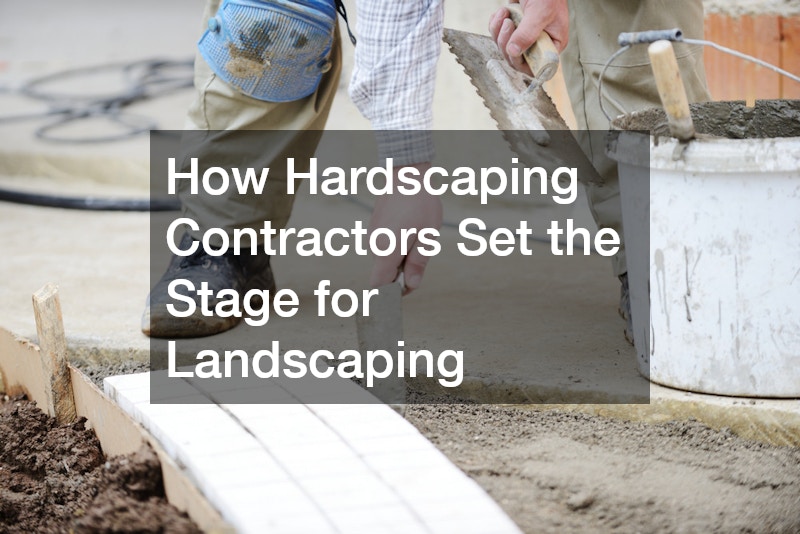
Laying stone or pouring concrete seems straightforward, but doing it correctly requires technical skill. If the base layer isn’t prepared properly, patios sink, walls lean, and pavers heave when the ground freezes and thaws. To prevent this, hardscaping contractors excavate deep into the soil. They remove unstable topsoil and replace it with strong base materials. They lay down gravel, compact it with heavy machines, and level it with sand before adding surface materials. This preparation takes time and involves machinery, which causes temporary chaos in the yard.
Because this process requires tearing up the ground, it must happen before plants go in. You can’t drive a skid steer over a fresh lawn or dump gravel next to flower beds. Heavy machinery compacts soil and tears up existing vegetation. Doing the structural work first protects the investment in plants and turf. Furthermore, materials chosen dictate the maintenance schedule for the yard. Solid stone and sealed concrete resist weeds and weather, providing a low-maintenance backbone for the yard. When the structural foundation remains stable year after year, it protects surrounding garden beds from shifting earth and crumbling borders. A solid foundation means the yard looks good decades later.
A functioning yard results from a balance between the built environment and the natural environment. While plants add color, texture, and life, they need a structured setting to thrive. Hardscaping contractors provide that setting. By addressing layout, drainage, zone creation, and stability, they turn unpredictable plots of land into organized, functional spaces. Their work with stone, concrete, and wood lays the groundwork for everything that follows.